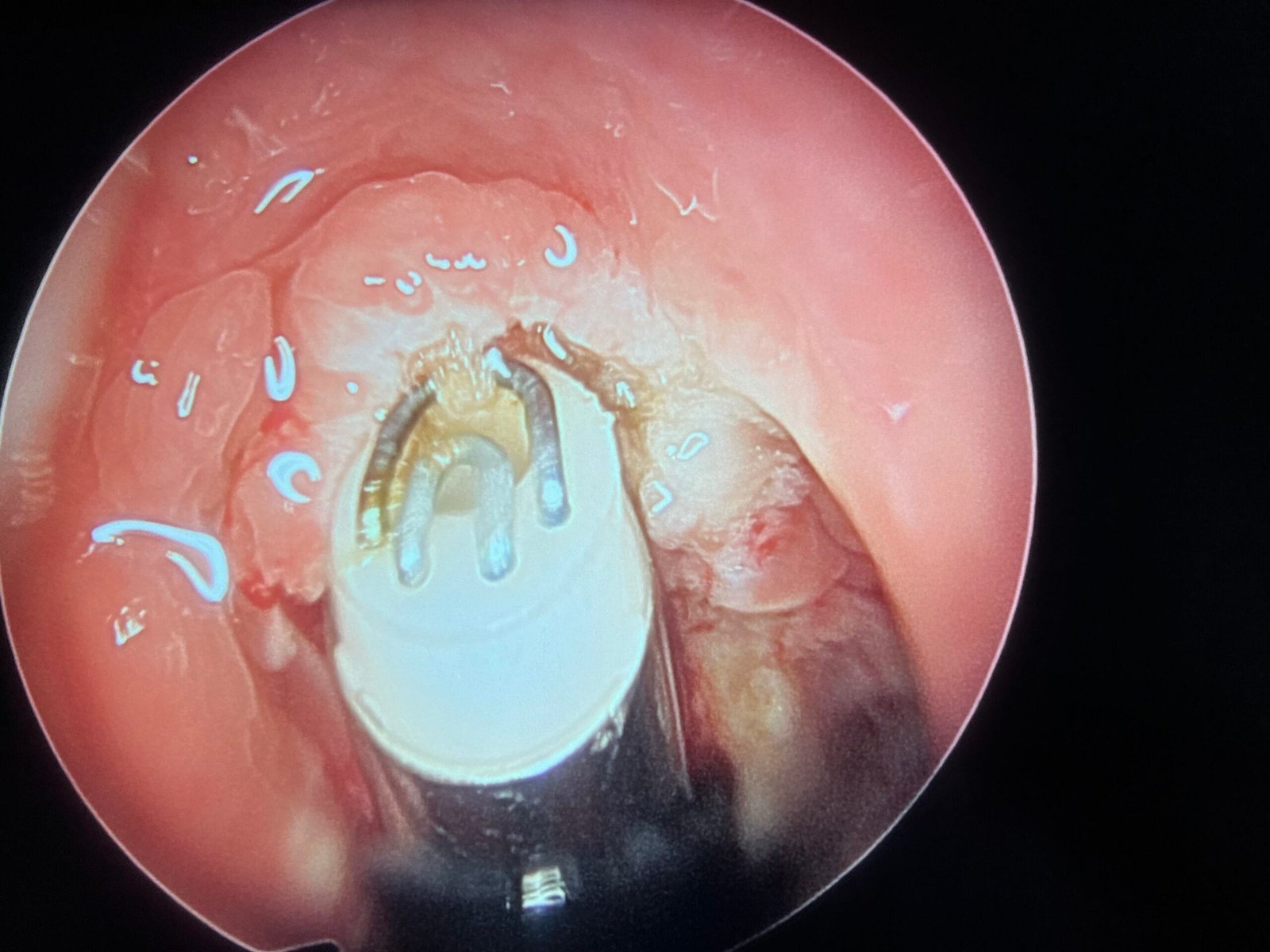
Endoscopic Coblator Adenoidectomy
- the lack of bleeding (abundant bleeding with curettage);
- provides a direct endoscopic view of the adenoid (blind surgery or mirror view with traditional cold curettage);
- the ability to reach all the areas up to the Eustachian tube opening (the cranial part of the rhinopharynx cannot be reached with curettage);
- lower risk of residual adenoid tissue after coblator surgery;
- fewer complications (no cutting blade with coblation adenoidectomy);
- it is suitable for patients of all ages, although the decrease of pain intensity and duration is important in paediatric patients;
- reduction in the use of post-operative drug and loss of working days for parents due to faster post-surgical healing.
Endoscopic Coblator Adenoidectomy: Advantages
Adenoidectomy is one of the common procedures performed in children with enlarged or chronically problematic adenoids. Traditionally, adenoid tissue was removed using blind curettage, a technique that has been used for many years.
While curettage can effectively remove adenoid tissue, the surgeon cannot directly see the entire adenoid bed during the procedure. This can make it difficult to identify and remove tissue extending into areas that are not easily accessible with a curette. Residual adenoid tissue may continue to contribute to nasal obstruction and other symptoms. See how residual adenoid tissue can affect airflow.
Endoscopic coblator adenoidectomy changes this approach by combining direct endoscopic visualization with controlled tissue removal using a coblation device.
The objective is not simply to remove the adenoids.
It is to see the tissue, identify its extent, remove it precisely and preserve the surrounding structures.
Why Endoscopic Visualization Matters
With an endoscope, the surgeon can directly visualize the adenoid tissue and the nasopharynx rather than relying on a blind technique or indirect mirror visualization.
This provides a much clearer view of the surgical field.
It can help the surgeon identify residual tissue around areas that may be difficult to reach with conventional curettage, including the upper and lateral aspects of the adenoid tissue and the region around the Eustachian tube openings.
This ability to see what is being removed is particularly important when the objective is complete adenoid removal.
Complete Removal Can Matter
The purpose of adenoidectomy is to remove the obstructive or problematic adenoid tissue while preserving important surrounding structures.
If significant residual tissue remains, symptoms may persist and, in some children, the adenoids may enlarge again over time.
Endoscopic visualization allows the surgeon to inspect the adenoid bed after removal and address residual tissue that may otherwise be difficult to identify.
This can be particularly valuable in children with significant nasal obstruction, mouth breathing, snoring, sleep-disordered breathing or recurrent problems associated with enlarged adenoids.
Complete removal, however, should never mean aggressive removal without regard for anatomy.
Precision is more important than force.
The Importance of Staying in the Correct Plane
One of the less discussed aspects of adenoidectomy is the surgical plane.
The adenoid tissue needs to be removed carefully while maintaining the appropriate plane between the adenoid tissue and the underlying structures.
If the dissection unnecessarily crosses the deeper fascial plane, there can be greater tissue trauma. This may contribute to increased postoperative pain and discomfort.
This is where surgical experience becomes particularly important.
A device such as a coblator can provide controlled tissue removal, but the instrument does not replace the surgeon’s anatomical knowledge or judgement.
Knowing how deep to go, where to stop and how to deal with tissue close to important structures requires experience.
The goal is to remove the adenoid tissue thoroughly without unnecessarily traumatizing the tissues underneath it.
Less Pain and Faster Recovery
When tissue trauma is minimized, recovery can be more comfortable.
Coblation allows the surgeon to remove tissue in a controlled manner, while endoscopic visualization helps guide the procedure precisely. When combined with careful preservation of the correct surgical plane, this approach may contribute to less postoperative discomfort and a faster return to normal activities.
This can be particularly meaningful in children.
A shorter recovery means fewer days away from school and, importantly, less disruption for parents who need to take time away from work or other responsibilities.
Other Potential Advantages
Compared with traditional blind curettage, an endoscopic coblation approach offers several potential advantages:
Direct visualization of the adenoid tissue and surgical field
Better access to areas that may be difficult to reach with a curette
Greater precision during tissue removal
Ability to inspect the adenoid bed for residual tissue
Controlled tissue removal with coblation
Potentially less tissue trauma
Reduced postoperative discomfort in appropriately performed cases
Faster recovery and earlier return to normal activities
The actual benefits, however, depend on the child’s anatomy, the extent of adenoid disease and the surgeon’s technique and experience.
Technology Helps — But Experience Matters More
It is tempting to think that the coblator itself is responsible for the better outcome.
It isn’t.
The technology is a tool. The surgeon determines how that tool is used.
Endoscopic visualization provides the eyes. Coblation provides the instrument. But the surgeon provides the anatomical understanding, judgement, precision and experience required to use both effectively.
A good endoscopic adenoidectomy is therefore not simply about removing as much tissue as possible. It is about achieving appropriate and complete removal while respecting the surrounding anatomy and maintaining the correct surgical plane.
The Goal: Complete, Precise and Gentle Surgery
For children undergoing adenoidectomy, the objective should be straightforward:
Remove the problematic tissue completely, avoid unnecessary trauma, minimize pain and help the child recover quickly.
Endoscopic coblator adenoidectomy can provide the surgeon with better visualization and greater control than a traditional blind technique. But the ultimate outcome still depends heavily on training, anatomical knowledge and surgical experience.
The most important question is therefore not simply which device is being used.
It is how precisely the surgeon uses it.