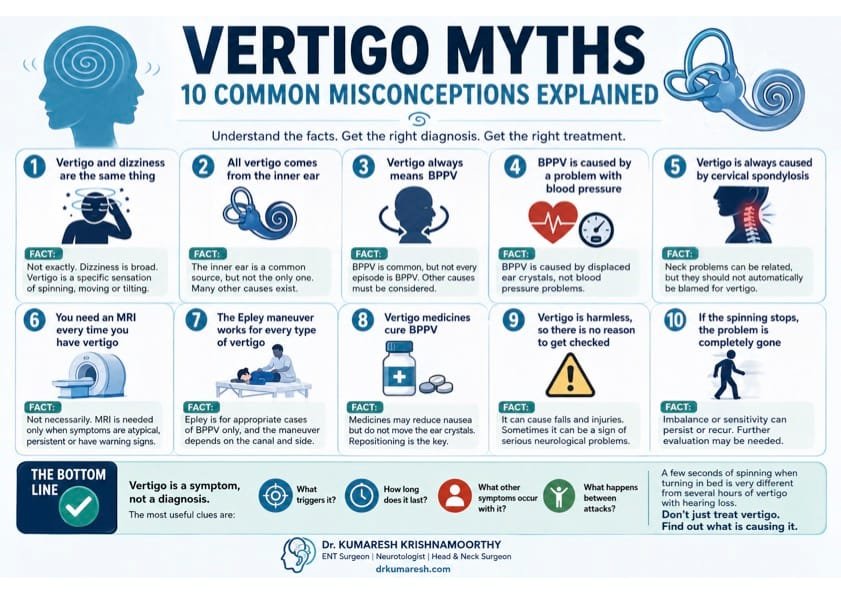
Vertigo myths – 10 common misconceptions explained
Vertigo Myth 1: Vertigo and dizziness are the same thing
FACT
Not exactly.
Dizziness is a broad term that can describe light-headedness, imbalance, floating, weakness or other unusual sensations.
Vertigo specifically refers to an illusion of movement — such as spinning, rotating, tilting, rocking or being pulled to one side.
Knowing exactly what you experience can help your doctor determine the possible cause.
Vertigo Myth 2: All vertigo comes from the inner ear
FACT
The inner ear is an important source of vertigo, but it is not the only one.
Vertigo can occur because of:
- BPPV
- Ménière’s disease
- Vestibular neuritis
- Vestibular migraine
- Other inner-ear disorders
- Neurological conditions
- Certain medications
- Other medical conditions
This is why persistent or unusual vertigo should be properly evaluated rather than automatically labelled as an “ear problem.”
Vertigo Myth 3: Vertigo always means BPPV
FACT
BPPV is a common cause of vertigo, but not every episode of vertigo is BPPV.
Typical BPPV produces brief spinning triggered by specific head movements, such as:
- Turning over in bed
- Looking up
- Bending down
- Lying down
- Sitting up
If your vertigo lasts for hours or days, occurs spontaneously, or is associated with hearing changes, migraine symptoms or neurological symptoms, another cause may need to be considered.
Myth 4: BPPV is caused by a problem with blood pressure
FACT
BPPV is caused by displaced otoconia (inner-ear crystals) entering a semicircular canal.
Blood-pressure problems can cause light-headedness, especially when standing suddenly, but that is different from typical positional vertigo.
Myth 5: Vertigo is always caused by cervical spondylosis
FACT
Neck problems can sometimes be associated with dizziness, but cervical spondylosis should not automatically be blamed for vertigo.
The vestibular system, migraine and other causes should be considered before concluding that the neck is responsible.
Myth 6: You need an MRI every time you have vertigo
FACT
Not necessarily.
If your symptoms and examination clearly fit a condition such as typical BPPV and there are no concerning features, imaging may not be necessary.
MRI may be appropriate when symptoms are atypical, persistent, unexplained or associated with neurological findings or other warning signs.
The decision for imaging should be based on the clinical evaluation, not simply on the presence of vertigo.
Myth 7: The Epley maneuver works for every type of vertigo
FACT
The Epley maneuver is designed to treat appropriate cases of BPPV, particularly posterior-canal BPPV.
It does not treat vestibular migraine, Ménière’s disease, vestibular neuritis or neurological causes of vertigo.
The correct maneuver also depends on which semicircular canal and which side are affected.
Myth 8: Vertigo medicines cure BPPV
FACT
Medicines may sometimes help control nausea or severe symptoms, but they do not reposition the displaced crystals responsible for BPPV.
For appropriate BPPV, canalith repositioning is the primary treatment.
Myth 9: Vertigo is harmless, so there is no reason to get checked
FACT
Many causes of vertigo are not dangerous, but the symptom can lead to falls and injuries.
More importantly, sudden vertigo can occasionally occur with neurological emergencies.
Seek urgent medical attention if vertigo is accompanied by:
- Weakness or numbness
- Difficulty speaking
- Double vision
- Severe new difficulty walking
- Loss of coordination
- Sudden severe headache
- Confusion
- Loss of consciousness
Myth 10: If the spinning stops, the problem is completely gone
FACT
Some people experience residual imbalance or motion sensitivity after an acute vestibular episode.
If symptoms continue, recur frequently or interfere with daily life, further evaluation may be needed.
The Bottom Line
Vertigo is a symptom, not a diagnosis.
The most useful clues are:
What triggers it?
How long does it last?
What other symptoms occur with it?
What happens between attacks?
A few seconds of spinning when turning in bed is very different from several hours of spontaneous vertigo with hearing loss.
Don’t just treat vertigo. Find out what is causing it.