Vertigo Attack: What to Do and What NOT to Do
A vertigo attack is not the time to “walk it off.”
I want to share a story that has stayed with me.
A patient once told me about his wife, who suffered from vertigo and subsequently fell, sustaining a serious injury that ultimately led to her death.
Her story is a painful reminder of something people often underestimate:
Vertigo can be dangerous — not only because of the spinning, but because of the fall that can follow.
What should you do during a vertigo attack?
DO:
- Sit or lie down immediately when the spinning starts.
- Stay still until the severe spinning settles.
- Move your head slowly and carefully.
- Get up gradually, especially from bed.
- Keep the room well lit if you need to get up at night.
- Have someone stay with you if you are at risk of falling.
- Seek medical evaluation if the attacks are recurrent, severe or unexplained.
These measures can reduce the immediate risk of falling.
What should you NOT do?
DON’T:
- Don’t try to walk through a severe attack.
- Don’t drive while you are dizzy or having vertigo.
- Don’t climb stairs or ladders during an attack.
- Don’t suddenly bend down or turn your head quickly.
- Don’t stretch or extend your neck unnecessarily during an acute attack.
- Don’t assume every episode of vertigo is simply an inner-ear problem.
And there is one more important warning.
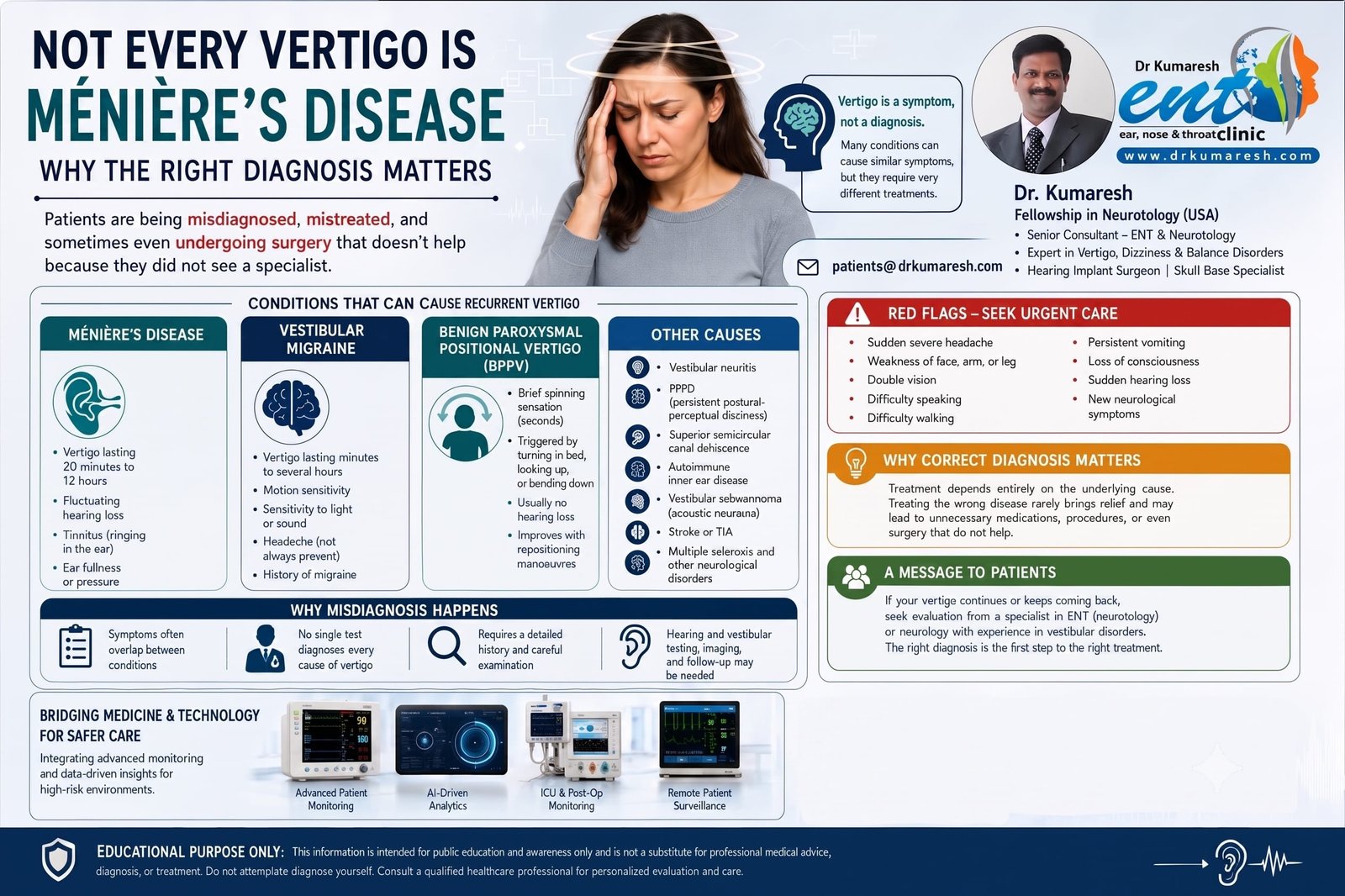
Sudden vertigo with any of these symptoms needs urgent medical attention:
- Weakness or numbness of the face, arm or leg
- Difficulty speaking
- Double vision or loss of vision
- Severe new headache
- Difficulty walking or inability to stand
- Sudden hearing loss
- Loss of coordination
These can be warning signs of a neurological emergency, including stroke.
Don’t wait for the spinning to stop before deciding what to do.
During a vertigo attack:
STOP. SIT. STAY SAFE. GET HELP.
Because sometimes the greatest danger isn’t the vertigo itself.
It’s the fall.