Vertigo Misdiagnosis: Why Your Symptoms Keep Coming Back
You’ve been dizzy for months. Maybe years.
You’ve seen a doctor. Maybe three. You’ve been told it’s stress. Or cervical spondylosis. Or simply “vertigo” — without a clear explanation of what is actually causing your symptoms.
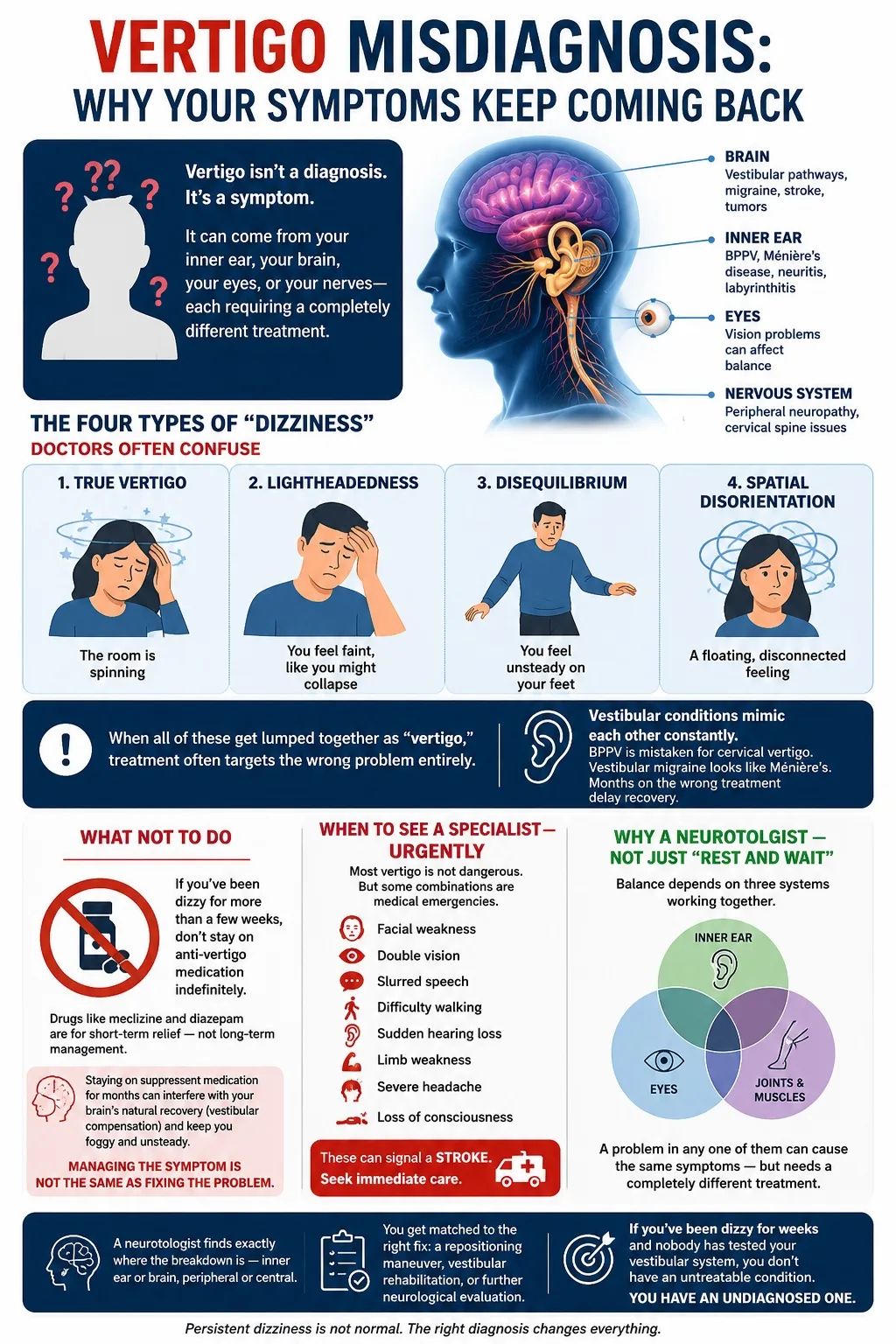
Here’s the problem: vertigo is a symptom, not a diagnosis. And dizziness can arise from the inner ear, brain, eyes, nerves, blood pressure or other systems — each requiring a different approach to evaluation and treatment.
When the underlying cause is not correctly identified, symptoms can persist, recur or be treated repeatedly without addressing the actual problem.
The Four Types of “Dizziness” Doctors Often Confuse
“Dizziness” means different things to different patients. Understanding exactly what you feel is one of the first steps toward finding the cause.
True vertigo — the room or surroundings feel as though they are spinning or moving
Lightheadedness — you feel faint, weak or as though you might pass out
Disequilibrium — you feel unsteady or off-balance, particularly while standing or walking
Spatial disorientation — you feel disconnected from your surroundings, as though you are floating or unable to judge where your body is in space
These sensations can overlap, but they do not necessarily have the same cause. When everything is simply labelled “vertigo,” the treatment may end up targeting the wrong problem.
It gets more complicated because vestibular disorders can mimic one another. BPPV, one of the most common and treatable causes of positional vertigo, may be confused with other causes of dizziness. Vestibular migraine can produce episodes that resemble other inner-ear disorders. Ménière’s disease can also present with vertigo, hearing symptoms and ear fullness, making a careful history and appropriate testing important.
The right diagnosis matters because the treatment depends on the cause.
What Not to Do
If you’ve been dizzy for more than a few weeks, don’t simply continue taking anti-vertigo medication indefinitely without reassessing the diagnosis.
Medicines such as meclizine and diazepam may be used in selected situations for short-term symptom control, but they are not a substitute for identifying and treating the underlying vestibular disorder. Prolonged use of vestibular suppressants can also interfere with the brain’s process of vestibular compensation in some patients recovering from vestibular injury.
Your brain can adapt when one balance system is impaired. Vestibular rehabilitation and appropriate activity may help this compensation process when indicated.
Managing the symptom is not always the same as treating the cause.
When to See a Specialist — Urgently
Most causes of vertigo are not life-threatening. However, some combinations of symptoms require urgent medical assessment.
Seek immediate medical attention if dizziness or vertigo occurs with facial weakness, double vision, slurred speech, difficulty walking, sudden hearing loss, limb weakness, severe headache, loss of consciousness or other new neurological symptoms.
These may indicate a serious neurological or vascular problem, including stroke, and should not be attributed automatically to an inner-ear condition.
Why a Neurotologist — Not Just “Rest and Wait”
Balance depends on information coming from several systems, particularly the inner ear, eyes, and sensory receptors in the muscles and joints. Your brain integrates these signals to help you understand where your body is and maintain balance.
A problem in any of these systems can produce symptoms that may feel surprisingly similar.
A neurotologist evaluates disorders of the ear and balance system and helps determine whether the problem is more likely to be peripheral, arising from the inner ear or vestibular nerve, or central, involving the brain.
Depending on the diagnosis, treatment may include a repositioning manoeuvre for BPPV, vestibular rehabilitation, medication for selected conditions, management of migraine-related dizziness, or further neurological evaluation.
The important point is this:
If you’ve been dizzy for weeks or months and the cause has never been properly established, don’t assume that you simply have to live with it. Persistent dizziness deserves a diagnosis — and the right diagnosis can change the treatment completely.