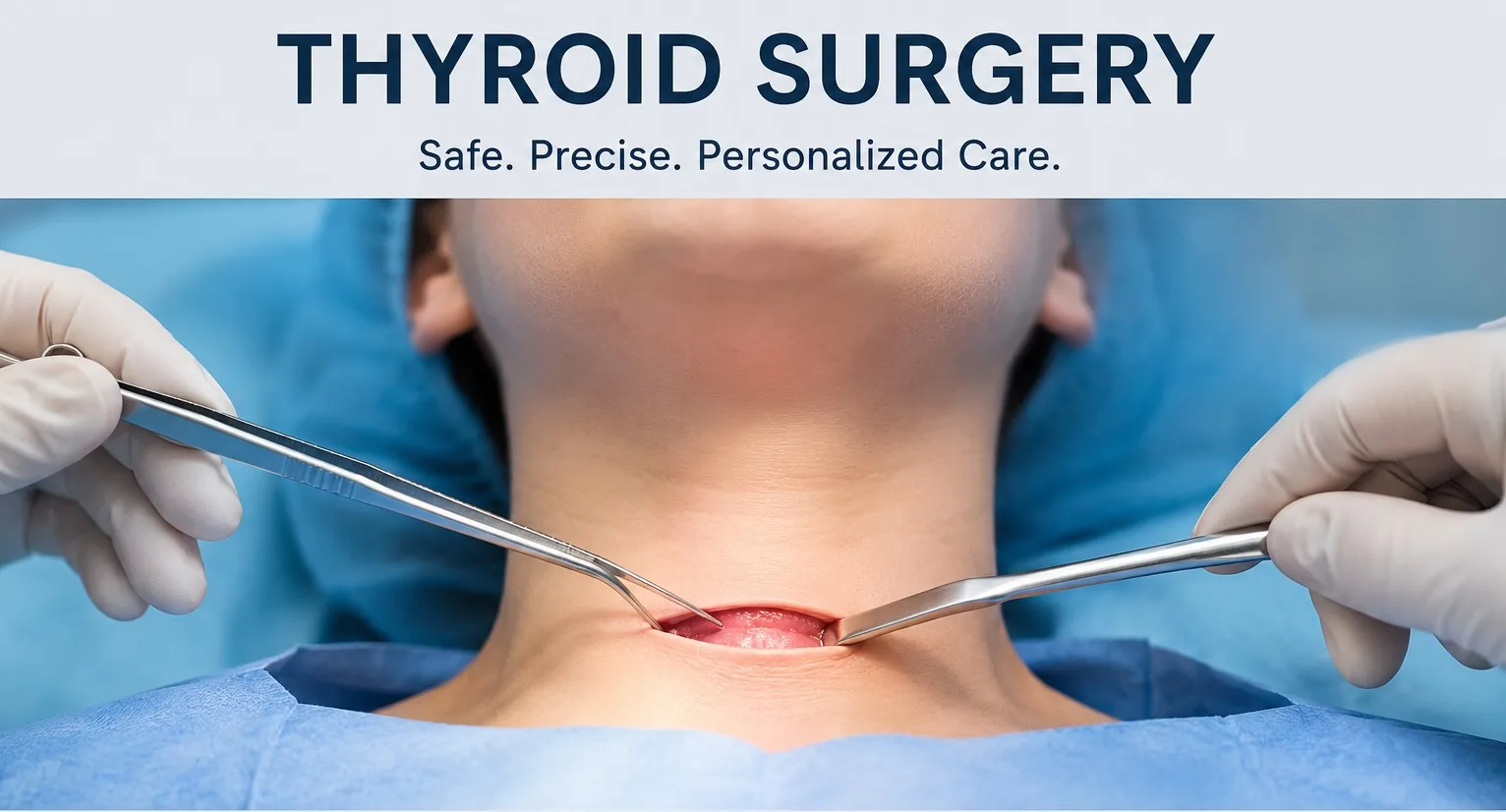
Thyroid Surgery: 16 Questions Patients Commonly Ask
If you’ve been told that you may need thyroid surgery, you probably have many questions.
Do I really need surgery? Can it be avoided? Will my entire thyroid have to be removed? Can I have a smaller incision? Will my voice change? Will I need thyroid medication for life? How long will recovery take? And perhaps most importantly — how do I choose the right thyroid surgeon?
Thyroid surgery is highly precise surgery performed in a small but anatomically complex area of the neck. Understanding why surgery is recommended, what operation is appropriate and what recovery involves can make the decision much less frightening.
Here are the questions I commonly hear from patients.
1. What is thyroid surgery?
Thyroid surgery, or thyroidectomy, is an operation to remove part or all of the thyroid gland.
Depending on the condition, surgery may involve:
- Lobectomy or hemithyroidectomy — removal of one lobe of the thyroid
- Total thyroidectomy — removal of essentially the entire thyroid gland
- Thyroidectomy with cervical lymph-node surgery — performed in selected thyroid cancers when lymph-node removal is indicated
The appropriate operation depends on the diagnosis, extent of disease and individual patient.
2. Can thyroid surgery be avoided?
Sometimes, yes.
Not every thyroid nodule, goitre or thyroid abnormality requires surgery.
Depending on the diagnosis, alternatives may include:
- Observation and ultrasound surveillance
- Repeat biopsy
- Medical treatment
- Treatment of an underlying thyroid disorder
- Other non-surgical approaches in selected situations
The important question is not simply:
“Can this be operated on?”
It is:
“Will this patient actually benefit from surgery?”
Surgery should be recommended when the expected benefit outweighs the risks of the operation.
3. When is thyroid surgery actually necessary?
Thyroid surgery may be recommended for several reasons, including:
- Thyroid cancer
- A thyroid nodule suspicious for or proven to be cancer
- Selected indeterminate thyroid nodules
- A large goitre causing difficulty swallowing or breathing
- Significant pressure or compression symptoms
- Selected cases of hyperthyroidism
- Certain thyroid conditions where surgery provides an appropriate treatment option
But remember:
Not every thyroid nodule requires surgery.
The decision should follow proper clinical assessment and, where appropriate, ultrasound, biopsy and other investigations.
4. Does every thyroid cancer require the whole thyroid to be removed?
No.
Some appropriately selected thyroid cancers can be treated with lobectomy or hemithyroidectomy, removing only the affected side.
Other patients may benefit from total thyroidectomy depending on factors such as:
- Tumour size
- Location
- Type of thyroid cancer
- Extension outside the thyroid
- Lymph-node involvement
- Distant spread
- Other individual risk factors
The word “cancer” does not automatically mean “remove the entire thyroid.”
The extent of surgery should be tailored to the individual cancer and patient.
5. Can thyroid surgery be done through a small incision?
Yes, in appropriately selected patients.
A mini-incision thyroidectomy uses a smaller cervical incision while maintaining the principles of safe thyroid surgery.
Potential advantages include:
- A more discreet scar
- Less tissue dissection in selected patients
- Potentially faster recovery in appropriately selected cases
However, smaller does not automatically mean better.
The patient’s anatomy, thyroid size, disease, cancer extent and the need for lymph-node surgery must all be considered.
The incision should be made smaller only when this can be achieved without compromising adequate exposure, nerve preservation or oncological safety.
6. Can thyroid surgery be done without a scar?
Conventional thyroid surgery requires an incision in the neck.
There are alternative approaches marketed as “scarless” thyroid surgery that access the thyroid through other anatomical routes, but these are not appropriate for every patient or every thyroid condition.
For many patients, a small, well-placed neck incision within a natural skin crease provides an excellent balance between surgical access and cosmetic outcome.
The priority should always be safe and appropriate surgery, rather than eliminating a scar at the expense of adequate treatment.
7. Will thyroid surgery leave a visible scar?
Thyroid surgery requires an incision in the lower neck.
The incision is usually placed within a natural skin crease, and the scar generally becomes less noticeable as it matures.
Scar appearance varies between individuals and depends on:
- Individual skin type and healing tendency
- Incision placement
- Surgical technique
- Wound healing
- Postoperative scar care
A scar can improve considerably over time, but no responsible surgeon should promise a completely invisible scar after conventional thyroid surgery.
8. Will my voice change after thyroid surgery?
The thyroid lies extremely close to the nerves responsible for movement of the vocal cords, particularly the recurrent laryngeal nerves.
Voice changes can occur after thyroid surgery. Some may be temporary, while significant nerve injury can cause vocal-cord paralysis.
This is why meticulous identification and preservation of the recurrent laryngeal nerve is a fundamental part of safe thyroid surgery.
For people whose voice is central to their profession — such as singers, teachers, public speakers and voice professionals — this deserves particular attention before surgery.
9. Can thyroid surgery damage the parathyroid glands?
The parathyroid glands are tiny glands located close to the thyroid that regulate calcium levels in the body.
They are identified and preserved during surgery whenever possible, including preservation of their blood supply.
If their function is temporarily reduced after surgery, calcium levels can fall.
Symptoms of low calcium can include:
- Tingling around the lips
- Tingling in the fingers
- Muscle cramps
- Muscle spasms in more significant cases
When hypocalcaemia occurs, it can often be managed with calcium and, when required, vitamin D supplementation while parathyroid function recovers.
This is why appropriate calcium monitoring and postoperative follow-up are important after thyroid surgery.
10. What are the important complications of thyroid surgery?
Thyroid surgery is generally safe when performed appropriately, but no operation is completely risk-free.
Important potential complications include:
- Bleeding or neck haematoma
- Voice or vocal-cord problems
- Temporary or permanent hypocalcaemia
- Parathyroid dysfunction
- Wound infection, which is uncommon
- Scar-related problems
- Additional risks associated with extensive lymph-node surgery
Emergency warning: A rapidly increasing neck swelling or difficulty breathing after thyroid surgery is a medical emergency and requires immediate medical attention.
11. How long will I stay in hospital after thyroid surgery?
Many patients can leave hospital relatively soon after an uncomplicated thyroid operation.
The appropriate observation period depends on:
- Type of surgery
- Extent of surgery
- Calcium considerations
- Bleeding risk
- Other medical conditions
- Individual recovery
- Hospital protocols
Some appropriately selected patients may be discharged the same day or the following day, while more extensive cancer surgery may require longer observation.
12. Is thyroid surgery painful?
Most patients experience some discomfort after thyroid surgery, but it is generally manageable with appropriate pain relief.
You may experience:
- Neck discomfort
- Tightness around the incision
- Mild swallowing discomfort
- Neck stiffness
- Discomfort when turning the neck
The intensity and duration vary between patients and depend partly on the extent of surgery.
13. How long does it take to recover from thyroid surgery?
Recovery varies from person to person and depends on the type of operation.
After an uncomplicated thyroid operation:
- Light activities: Many patients resume these relatively quickly.
- Desk work: Many patients can return within approximately 1–2 weeks, depending on their recovery and occupation.
- Strenuous activity: Heavy lifting and intense exercise are usually restricted for a period advised by the surgeon, often around 2–3 weeks after uncomplicated surgery.
- Scar healing: The incision continues to heal for weeks, while the scar can continue to mature and fade over several months.
These are general recovery ranges, not fixed deadlines.
14. Will I need thyroid medicine after thyroid surgery?
It depends on how much thyroid tissue remains.
After total thyroidectomy
Daily thyroid hormone replacement is required for life.
After hemithyroidectomy
The remaining thyroid may produce enough hormone on its own.
However, some patients develop hypothyroidism and require medication.
Thyroid function is therefore monitored after surgery, and medication is prescribed when required.
15. Can I live a normal life without a thyroid?
Yes.
After total thyroidectomy, thyroid hormone can be replaced with a daily thyroid hormone tablet.
Once the appropriate dose has been established and monitored through blood tests, most people can:
- Work
- Exercise
- Travel
- Eat normally
- Lead an active life
- Participate in their usual activities
Having your thyroid removed does not mean that you have to live a restricted life.
16. How do I choose the right thyroid surgeon?
This may be one of the most important decisions you make.
Don’t choose a thyroid surgeon simply because they “perform thyroid operations.”
Look for specific experience in:
- Thyroid surgery
- Head and neck surgery
- Thyroid cancer surgery
- Cervical lymph-node surgery when required
- Recurrent laryngeal nerve preservation
- Parathyroid preservation
- Hemithyroidectomy and total thyroidectomy
- Complex or recurrent thyroid disease
- Appropriate selection of the extent of surgery
Experience matters because thyroid surgery is precision surgery.
In my own practice, I have performed more than 500 thyroid surgeries, including surgery for thyroid cancer and complex thyroid procedures.
The objective is never simply to perform the biggest operation or the smallest operation.
It is to perform:
The right operation.
For the right patient.
For the right reason.
With the greatest attention to safety and oncological adequacy.
Final Takeaway
If you have been advised to undergo thyroid surgery, don’t make your decision based on fear.
Ask:
- Do I really need surgery?
- Can my condition be safely managed without surgery?
- How much of my thyroid actually needs to be removed?
- Is a less extensive operation appropriate for me?
- Can my surgery be performed through a smaller incision?
- What are the specific risks in my case?
- Will I need thyroid hormone replacement?
- What should I expect during recovery?
- Who will be performing my operation?
- What specific experience does that surgeon have with thyroid and head-and-neck surgery?
Thyroid surgery is performed in a small area of the neck containing important nerves, glands and blood vessels.
The right diagnosis, the right operation and the right surgeon all matter.
And when thyroid surgery is genuinely needed, the goal should never be simply to remove the thyroid.
The goal is to treat the disease adequately while preserving everything that can safely be preserved.