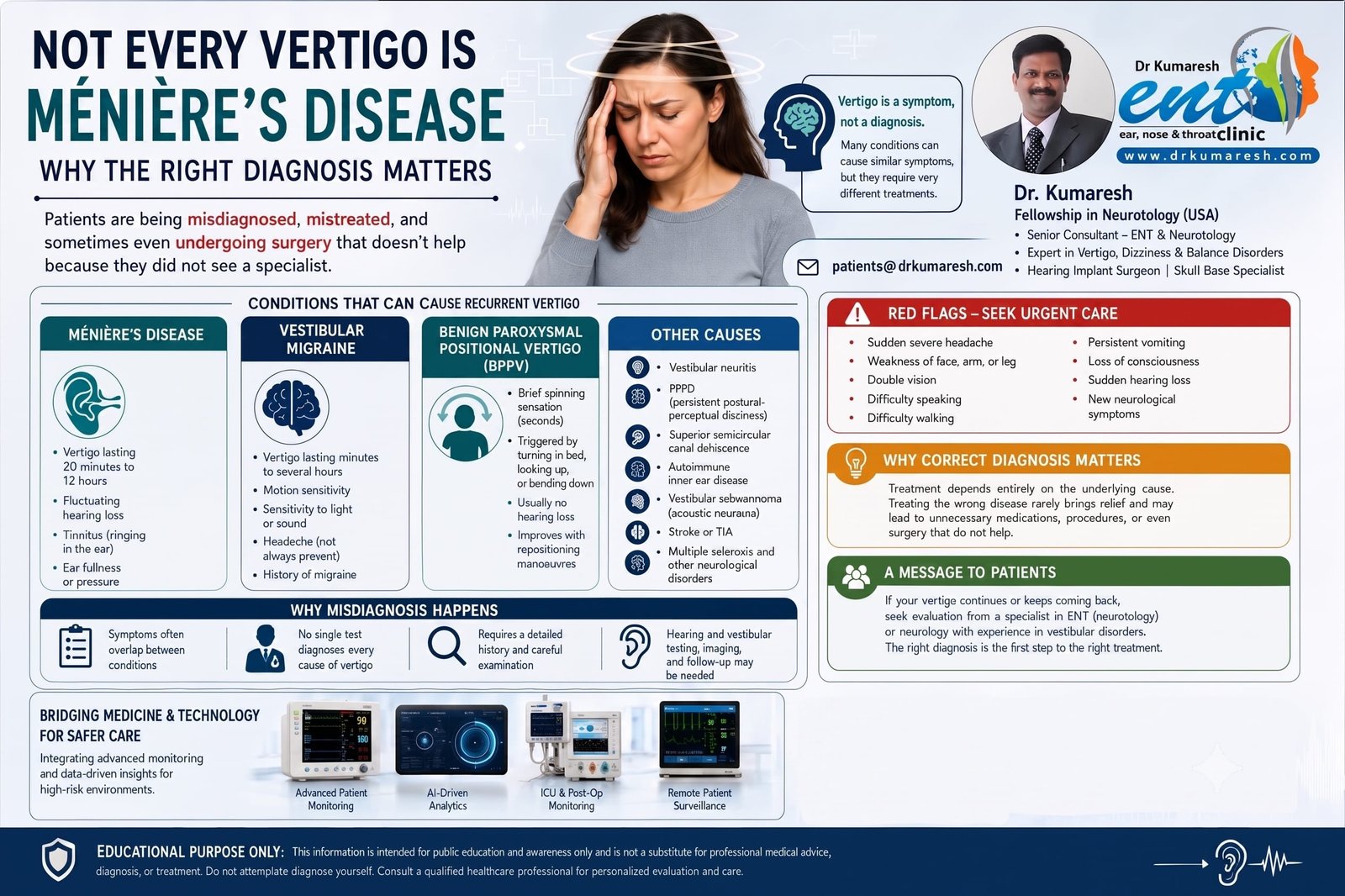
Not Every Vertigo Is Ménière’s Disease
If you have been diagnosed with Ménière’s disease—or suspect you have it—it is worth pausing before accepting the label.
Vertigo is a symptom, not a diagnosis.
The sensation of spinning, tilting, imbalance or being pulled to one side can arise from several different disorders. Because many of these conditions can produce similar symptoms, distinguishing between them requires more than simply asking whether you feel dizzy.
An incorrect diagnosis can result in ineffective treatment, unnecessary medication and, in selected cases, delay appropriate intervention.
Common Causes of Recurrent Vertigo
Ménière’s Disease
Ménière’s disease typically causes spontaneous episodes of vertigo lasting 20 minutes to 12 hours. In definite Ménière’s disease, there is documented low- to medium-frequency sensorineural hearing loss, together with fluctuating aural symptoms such as hearing changes, tinnitus or aural fullness.
The relationship between vertigo and hearing symptoms is therefore an important part of the diagnostic picture.
Vestibular Migraine
Vestibular migraine is another important cause of recurrent vertigo and dizziness. Episodes may last from 5 minutes to 72 hours.
Patients may experience motion sensitivity, visual sensitivity, nausea, imbalance or intolerance to busy visual environments. Importantly, a headache does not have to occur during every vestibular episode.
This is one reason vestibular migraine can sometimes be mistaken for an inner-ear disorder.
Benign Paroxysmal Positional Vertigo (BPPV)
BPPV is one of the most common causes of positional vertigo.
The characteristic episodes are usually brief, often lasting seconds, and are triggered by changes in head position—such as rolling over in bed, looking upward or getting up.
Hearing is generally unaffected.
BPPV is diagnosed through appropriate positional testing and, when confirmed, is treated primarily with canalith repositioning manoeuvres, such as the Epley manoeuvre for appropriate posterior-canal BPPV. Medication does not correct the underlying displaced particles.
Other Causes That Can Be Overlooked
Not all recurrent dizziness comes from the three conditions above.
Other possibilities include Persistent Postural-Perceptual Dizziness (PPPD), vestibular neuritis, superior canal dehiscence syndrome, vestibular schwannoma and other peripheral or central vestibular disorders.
Some neurological conditions can also present with dizziness or vertigo and must not be missed.
Why Does Misdiagnosis Occur?
There is no single blood test or scan that confirms every cause of vertigo.
The diagnosis starts with a detailed clinical history and a careful neurotological examination.
Important questions include:
- How long does each episode last?
- Is it spontaneous or triggered by movement?
- Is there hearing loss, tinnitus or ear fullness?
- Are there migraine-related symptoms?
- Is the patient sensitive to motion or visual stimuli?
- Are there neurological symptoms?
Depending on the suspected diagnosis, investigations may include pure-tone audiometry, vestibular testing such as VNG or VEMP, and targeted imaging.
The tests should support the clinical diagnosis rather than replace it.
Red Flags: When Vertigo Needs Urgent Assessment
Vertigo requires urgent medical evaluation when it occurs with symptoms such as:
- Sudden, severe headache
- Facial weakness or asymmetry
- Arm or leg weakness or numbness
- Double vision
- Slurred speech
- New severe difficulty walking or standing
- Other new neurological symptoms
- Sudden hearing loss, particularly when associated with acute vertigo
These symptoms can indicate conditions requiring urgent treatment, including stroke or sudden sensorineural hearing loss.
The Right Diagnosis Comes First
The treatment of vertigo depends entirely on its underlying cause.
A patient with BPPV requires a very different approach from someone with Ménière’s disease. Vestibular migraine requires another treatment strategy altogether.
Treating every patient with vertigo as though they have Ménière’s disease can delay the correct diagnosis and appropriate treatment.
If your vertigo is recurrent, unexplained or not responding to treatment, consider evaluation by an ENT specialist with expertise in neurotology and vestibular disorders, or a neurologist experienced in dizziness and balance disorders.
The key message
Don’t just ask, “How do I treat my vertigo?”
First ask, “What is actually causing it?”
That is where appropriate treatment begins.