Cartilage Graft Ear Surgery: Why Surgical Precision and Experience Matter
Not all ear surgeries are the same — and not all surgical situations present the same level of complexity. This becomes particularly important in cartilage graft ear surgery, a technique commonly used to repair a perforated eardrum and reconstruct the middle ear, especially in selected patients undergoing revision ear surgery.
Cartilage is valued in tympanoplasty because of its structural strength and stability. Compared with thinner graft materials, cartilage can provide greater resistance to retraction, making it particularly useful in certain challenging ears, including some revision cases where the tissues have already undergone surgery.
But cartilage grafting is not simply about placing cartilage over a perforation.
The real skill lies in precision.
One important aspect is preparing the cartilage to an appropriate thickness and shaping it according to the anatomy and reconstructive requirements of the individual ear.
If the cartilage is excessively thin, it may not provide the structural support required in a particular reconstruction. If it is excessively thick or poorly positioned, it can potentially affect the mechanics of sound transmission. The objective is therefore not simply to use cartilage, but to use it appropriately — with careful attention to thickness, shape, placement and the overall middle-ear reconstruction.
This is where experience in complex ear surgery becomes particularly important.
An experienced otologist understands that every ear is different. Previous surgery, the size and location of the perforation, the condition of the middle-ear structures, the ossicles, the Eustachian tube function and the patient’s hearing status can all influence the surgical approach.
A Patient’s Journey
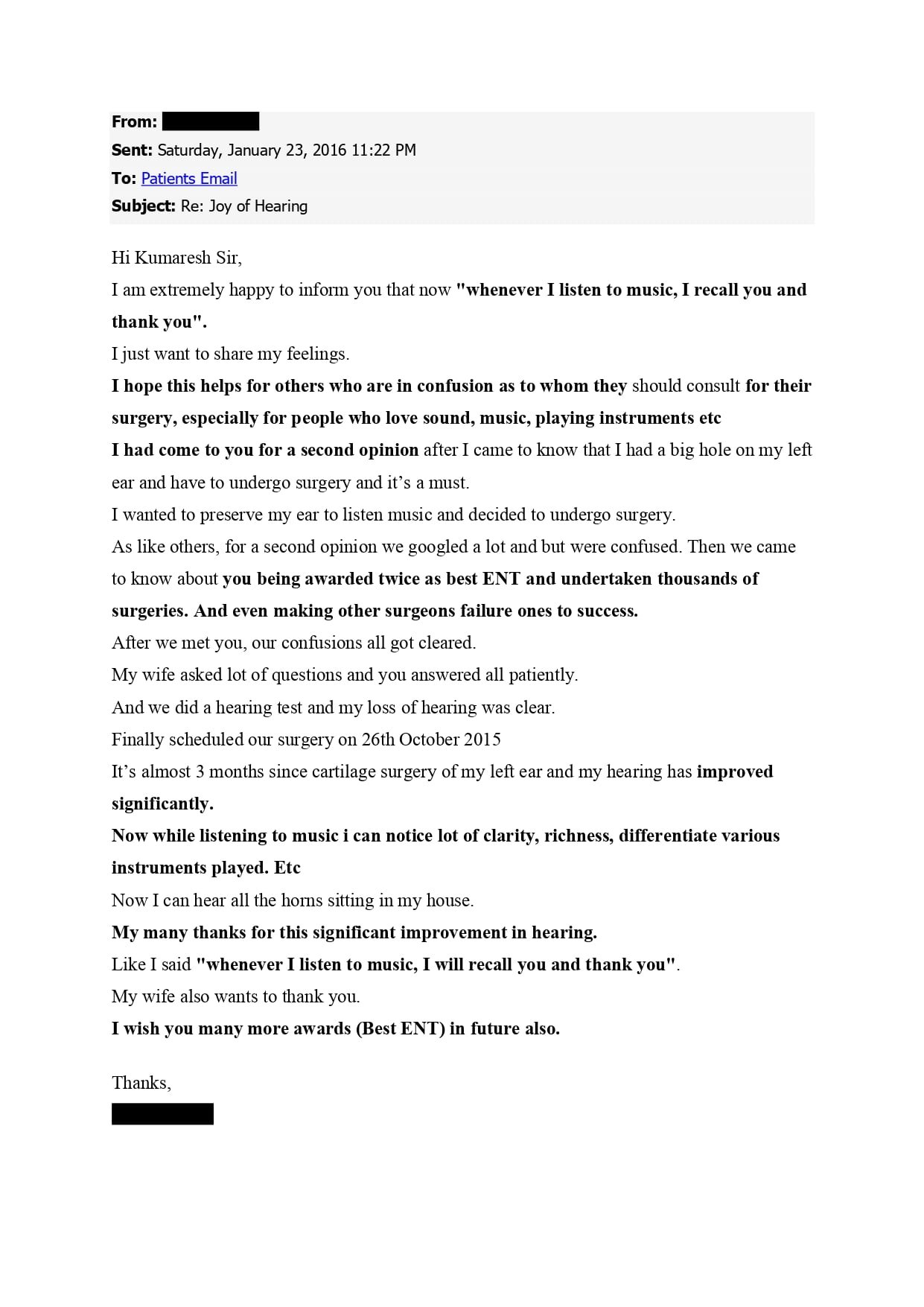
One recent patient came to us for a second opinion after being diagnosed with a large perforation in his left eardrum and being advised to undergo surgery.
Understandably, he and his wife wanted to understand their options carefully before proceeding. They researched extensively and were particularly concerned because revision and complex ear surgeries can require meticulous planning and reconstruction.
Following a detailed clinical evaluation and hearing assessment, we discussed the condition of his ear and the surgical options available.
He subsequently underwent cartilage graft ear surgery on his left ear.
Approximately three months after surgery, he reported a significant improvement in the clarity and quality of his hearing.
One of the most meaningful changes was while listening to music.
He described being able to appreciate greater clarity and richness and, importantly, distinguish between different instruments playing together — something he had struggled to appreciate when his hearing was muffled.
He also mentioned something wonderfully simple: he could once again clearly hear the horns outside his house.
For someone who had been led to believe that a hearing aid would be his only lifelong option, being able to hear the horns outside his house clearly again represented something much bigger — the possibility of hearing naturally again and experiencing everyday sounds with a clarity he had almost stopped expecting.
He and his wife later expressed their heartfelt gratitude for the improvement they experienced.
Why Cartilage Grafting Requires Precision
A successful reconstruction is about more than closing an eardrum perforation.
The surgeon must consider how the reconstructed eardrum will function as part of the middle-ear sound-conduction system.
The choice and preparation of graft material, its thickness and shape, its position, and the condition of the middle-ear structures all matter.
This becomes even more important during revision ear surgery, where normal anatomy may have been altered by previous surgery and scar tissue may be present.
Revision surgery can therefore require a different level of planning and technical judgement from a straightforward first-time procedure.
Why Experience Matters in Revision Ear Surgery
When a previous ear operation has not produced the desired result, patients naturally want to know what can be done differently the second time.
There is no single solution that works for every patient.
The surgeon must first understand why the previous reconstruction failed or did not achieve the expected result. Only then can an appropriate revision strategy be planned.
This is why choosing an experienced otologist is important when considering complex or revision ear surgery.
Experience does not guarantee a particular outcome — every patient’s anatomy and healing response are different. But specialized training and experience can help the surgeon make better-informed decisions about graft selection, preparation, placement and reconstruction.
The Goal Is Functional Hearing, Not Just a Closed Perforation
For patients, the ultimate goal is rarely simply to have a closed eardrum.
They want to hear better.
They want to follow conversations more easily, enjoy music again, hear sounds around them and return to everyday life with greater confidence.
That is why cartilage graft ear surgery should be approached as a functional reconstruction rather than simply a procedure to close a hole in the eardrum.
If you have an eardrum perforation, persistent hearing loss, or are considering revision ear surgery after a previous procedure, a detailed evaluation by an experienced otologist can help determine the most appropriate treatment for your individual ear.
The right surgical plan begins with understanding not just the perforation — but the ear behind it.