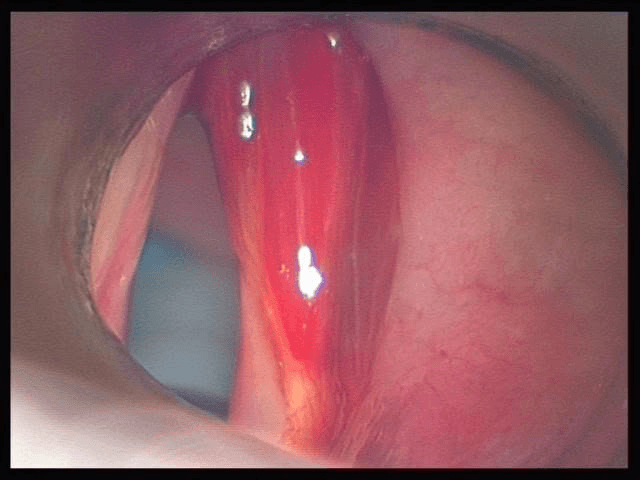
Haemorrhagic Vocal Cord Polyp: Why Precision Matters in Voice Surgery
A persistent change in the voice should never be dismissed as “just a throat problem.”
A haemorrhagic vocal cord polyp is a benign lesion of the vocal fold that can significantly affect the quality, strength and endurance of the voice. Although it is not a cancer, its location is extremely important. The vocal cord is a highly specialised structure, and even a small alteration in its delicate architecture can produce a noticeable change in the voice.
What is a haemorrhagic vocal cord polyp?
A vocal cord polyp is a localised swelling or lesion arising from the vocal fold. In a haemorrhagic polyp, bleeding occurs within the delicate tissues of the vocal fold, producing the characteristic reddish or blood-filled appearance.
It commonly develops following phonotrauma, particularly when the voice is used forcefully or excessively.
Common contributing factors include:
- Excessive or prolonged voice use
- Shouting or screaming
- Professional voice use
- Sudden intense voice use
- Smoking
- Chronic coughing or throat clearing
- Acid reflux or laryngopharyngeal reflux
- Poor voice technique
- Repeated irritation of the vocal cords
It can occur in anyone, but it becomes particularly important when the person’s livelihood depends on the voice.
What symptoms can it cause?
The most common symptom is persistent hoarseness.
Patients may describe their voice as:
- Rough or husky
- Breathier than before
- Weak or strained
- Easily fatigued
- Difficult to project
- Lower or different in pitch
- Associated with frequent throat clearing
A singer may notice that certain notes are no longer possible. A teacher may find that the voice becomes tired by afternoon. A businessman or executive may struggle to speak for prolonged periods during meetings.
For such individuals, a change in voice is not merely a medical inconvenience. It can directly affect their professional performance.
What you should not do if you have a persistent hoarse voice
When the voice changes and does not settle, certain reactions are common — and unhelpful.
Do not assume it is “just a strain” and wait indefinitely.
A few days of hoarseness after a cold or a loud event is normal. Hoarseness that persists beyond two to three weeks is not something to keep waiting out.
Do not rely on voice rest alone as a long-term strategy.
Voice rest has a role early on, particularly after acute vocal trauma. But rest alone will not resolve a well-established haemorrhagic polyp — it only delays proper evaluation.
Do not self-treat with home remedies as a substitute for examination.
Steam inhalation, warm fluids and reduced voice use may offer comfort, but they cannot tell you what is actually happening on the vocal fold. Only direct visualisation can.
Do not ignore the underlying trigger.
If reflux, smoking, chronic throat clearing or poor vocal technique is contributing to the problem, treating the polyp without addressing the cause increases the chance of recurrence — even after successful surgery.
Do not assume every lesion is “just a polyp.”
Vocal fold lesions can look similar to the naked eye but behave very differently. Presuming a diagnosis without proper laryngoscopic assessment can delay appropriate treatment.
Can a vocal cord polyp disappear on its own?
Some early vocal-fold lesions, particularly those associated with recent vocal trauma, may improve with appropriate voice rest, correction of vocal technique, treatment of contributing factors such as reflux, and professional voice therapy.
However, a well-established haemorrhagic polyp may persist despite conservative treatment.
When a polyp remains, is large, significantly affects the voice, or interferes with the patient’s profession, surgical removal may be recommended.
The important point is that vocal cord surgery is not simply about removing a growth.
It is about preserving the voice-producing mechanism of the vocal fold.
Why is surgery often the best option for a persistent haemorrhagic polyp?
The vocal folds vibrate hundreds of times per second during normal speech. Their ability to produce a good voice depends on the precise interaction of several delicate tissue layers.
A persistent polyp alters this vibration.
Simply waiting indefinitely for a well-established lesion to disappear may allow the abnormality to persist and can result in continued voice dysfunction. In selected patients, microlaryngeal surgery allows the surgeon to remove the abnormal lesion while attempting to preserve the normal architecture of the vocal fold.
This is where the surgeon’s experience becomes critically important.
Vocal cord surgery is a surgery of millimetres — and sometimes less
Incising too superficially, too deeply, or removing the wrong tissue can affect the vibration of the vocal fold.
The goal is not merely:
“The polyp has been removed.”
The real goal is:
“The polyp has been removed and the vocal fold continues to vibrate as normally as possible.”
This distinction is extremely important.
Why choosing the right surgeon matters
Vocal cord surgery is one area of ENT where experience and frequency of performing the procedure matter enormously.
A surgeon who regularly performs microlaryngeal and phonosurgery develops an understanding of the three-dimensional anatomy of the vocal fold, the tissue planes, the effect of different instruments and, most importantly, how much tissue should be preserved.
When your voice is your profession, your communication tool or an essential part of your identity, choosing a surgeon who regularly performs these delicate procedures can make a meaningful difference to the final voice outcome.
Do not choose a surgeon merely because the polyp can be removed. Choose one who understands that the real objective is to remove the polyp while preserving the voice.