Complex Revision Thyroid Surgery: When Expertise Matters
I have been performing complex Head and Neck surgeries for many years — including challenging thyroid, head and neck cancer, skull base and reconstructive procedures. Some of these cases require far more than simply removing the diseased organ. They demand a detailed understanding of anatomy, meticulous surgical technique, and the ability to manage structures that may be distorted by previous surgery.
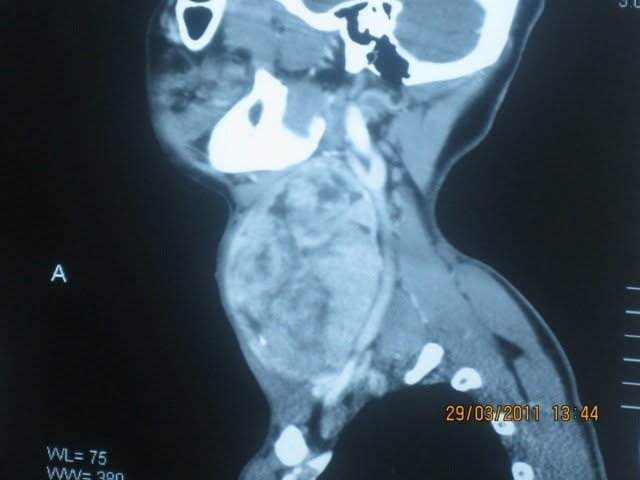
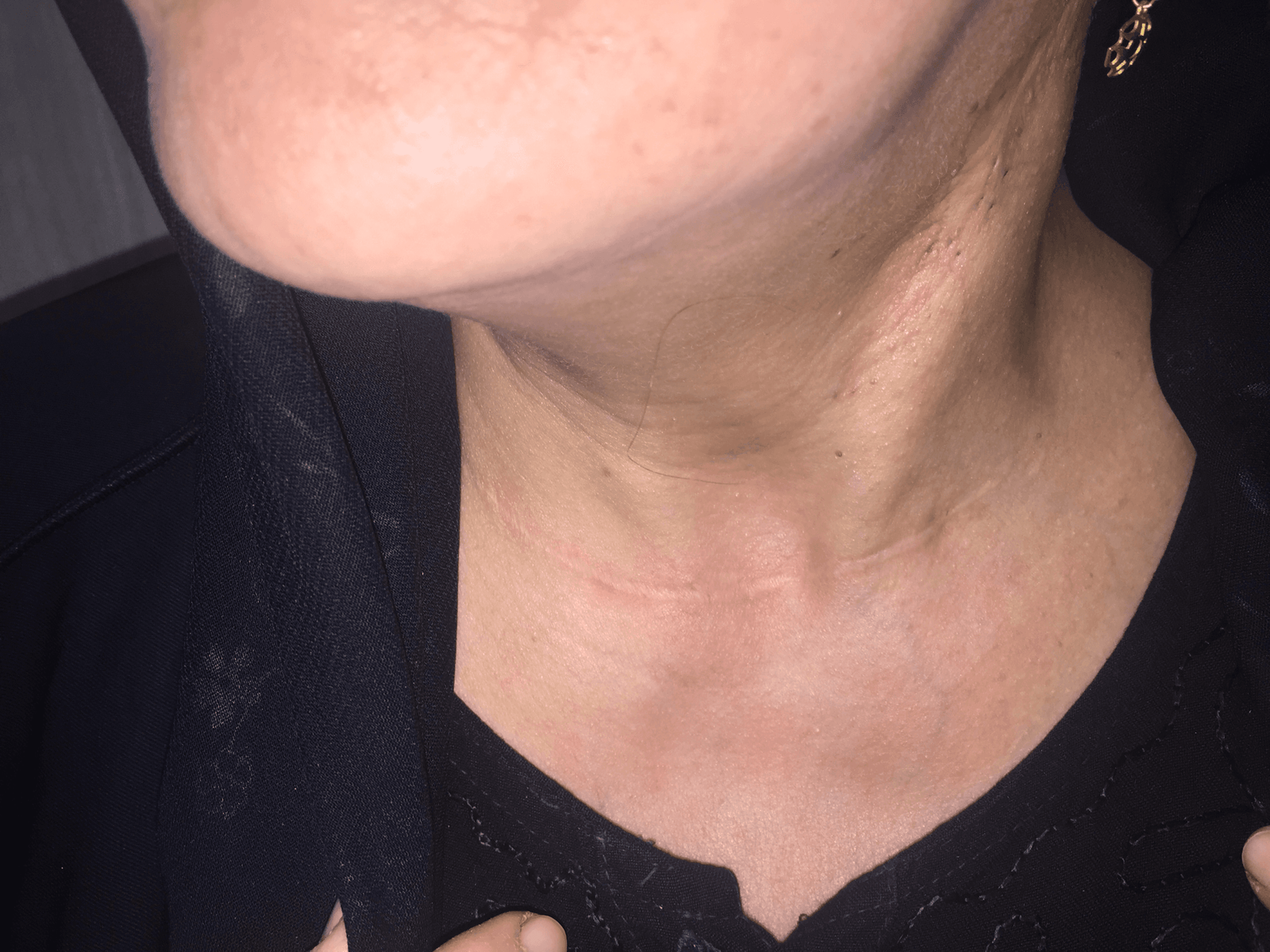
The images above are from one such challenging case.
The case
The CT scan shows a recurrent thyroid swelling — extending unusually high in the neck, almost up to the level of the jaw, and deep enough to closely encase the major blood vessels of the neck, with disease extending toward the posterior aspect. The trachea itself was visibly compressed and displaced.
This patient underwent a total thyroidectomy in a revision setting — meaning this was not the first operation on this neck. It was the second.
That single fact changes everything about how such a surgery has to be approached.
Why revision thyroid surgery is considerably more challenging than a first-time operation
In a first-time thyroid surgery, the tissue planes are clean and the anatomy largely follows what any textbook describes. None of that can be assumed in a revision case.
Previous surgery leaves dense scar tissue, distorts the normal anatomical planes, and often results in significant adherence of the thyroid to the surrounding structures. When the recurrent disease is this extensive, the surgeon has to work carefully around some of the most important structures in the human neck — without the benefit of clean, undisturbed anatomy to guide the way.
Several factors compound the difficulty in a case like this:
- Encasement of major vessels. Long-standing recurrent goiters can grow to encircle the carotid artery and jugular vein rather than simply lying beside them. Separating the tumour from vessels it has wrapped around demands extreme precision.
- Airway compression. A trachea that is compressed and pushed out of position changes the anaesthetic risk, the surgical positioning, and the margin for error throughout the operation.
- Nerve identification in distorted anatomy. The recurrent laryngeal nerve, which controls movement of the vocal cords, lies very close to the thyroid at the best of times. In a scarred, reoperated field, finding and preserving it — often without the clear landmarks a first-time surgery would offer — is one of the most demanding skills in thyroid surgery.
- Parathyroid preservation. The parathyroid glands are tiny but essential — they regulate calcium metabolism in the body. In a revision field, they are easily mistaken for scar tissue or lymph nodes, and losing them means a lifetime of calcium supplementation for the patient.
The objective in a case such as this is never merely to remove the thyroid. The real challenge is to achieve complete removal of the diseased tissue while preserving the nerves that control the voice, the parathyroid glands that control calcium, and the major blood vessels of the neck — often working within millimetres of all three at once.
This is also why, in select complex cases like this one — particularly large recurrences with vessel involvement — an extended or transverse incision across the neck may become necessary to safely control the anatomy. That is a deliberate decision made to prioritise safety over cosmesis, not a departure from technique.
What not to do with a large or recurrent neck swelling
Do not assume a second surgery will simply be “the same operation, a bit bigger.” Revision thyroid surgery is a fundamentally different undertaking from a first-time thyroidectomy, with a different risk profile entirely.
Do not delay surgery once significant airway compression is present. A swelling visibly pushing the trachea out of position will not resolve by waiting — it typically continues to enlarge.
Do not underestimate the value of proper pre-operative imaging. A detailed CT scan is not optional in a case like this. It is what allows the surgical team to plan the approach to the airway and the great vessels before the first incision is ever made.
Do not choose a surgeon or centre based on the assumption that “thyroid surgery is routine.” A small, first-time, well-localised thyroid nodule and a huge recurrent goiter encasing the major vessels are, for surgical purposes, almost different operations. Experience with the former does not automatically translate to safety in the latter.
Do not assume every incision can be hidden. Prioritising a cosmetically ideal incision over safe access to distorted, high-risk anatomy is not a trade a prudent surgeon makes.
When to see a specialist urgently
A recurrent neck swelling after previous thyroid surgery warrants prompt evaluation if there is:
- Progressive increase in the size of the swelling
- Difficulty breathing, or breathing that changes with position
- Voice change or hoarseness
- Difficulty swallowing
- Any visible or palpable pulsation suggesting vessel involvement
- A new swelling appearing at or near the site of a previous thyroid surgery
Why training and experience matter here
Complex Head and Neck surgery requires an intimate knowledge of anatomy — particularly when normal anatomical planes have been lost due to previous surgery or extensive disease. It requires the ability to anticipate complications, make precise decisions in real time, and safely dissect structures that may lie only millimetres from critical nerves and blood vessels.
Cases like this are a reminder that the complexity of a surgery is rarely apparent from the diagnosis alone. A procedure called a “thyroidectomy” can range from a relatively straightforward operation to one of the most demanding procedures in Head and Neck surgery.
In this case, the tumour was removed in full. The recurrent laryngeal nerve was identified and preserved. The parathyroid gland was preserved. The patient’s voice and calcium metabolism remained intact.
That outcome — not merely “the tumour is gone,” but the tumour is gone and every vital structure around it still functions — is the true measure of success in surgery of this complexity.
In complex Head and Neck surgery, precision is not optional. It is the foundation of safe surgery.
If you or someone you know has a recurrent or unusually large neck swelling — particularly after previous thyroid surgery — a detailed evaluation with an ENT/Head and Neck specialist is strongly recommended. [Book a consultation / Read more on the blog].